Showing posts with label national security. Show all posts

Thursday, May 12, 2022

Who's minding National Defense in South Korea?

Apparently, it's not the new president, Yoon Seok-yeol. Earlier today, Associated Press published this headline and article about North Korea:

N. Korea fires 3 ballistic missiles amid 1st virus outbreak

SEOUL, South Korea (AP) — North Korea fired three short-range ballistic missiles toward the sea on Thursday, its neighbors said, in the latest of a series of weapons demonstrations this year that came just hours after it confirmed its first case of the coronavirus since the pandemic began.

The launches could underscore North Korea’s determination to press ahead with its efforts to expand its arsenal despite the virus outbreak to rally support behind the leader, Kim Jong Un, and keep up pressure on its rivals amid long-dormant nuclear diplomacy.

Thursday’s launches were the North’s first weapons fired since the inauguration of new conservative South Korean President Yoon Suk Yeol on Tuesday.

https://apnews.com/article/seoul-south-korea-north-327a81d1281f2fadeb430e4c632458b7

The headline should have been: "North Korea fires 3 ballistic missiles at six thirty in the evening (Seoul time), President Yoon not available?" One pundit asked why didn't the president convene a National Security Council meeting per the normal government protocol? Has the NSC been replaced? President Yoon had probably already left the office for the day, and his executive office staff and their security office chief pieced together a national security situation evaluation meeting to issue a statement which addressed the threat North Korea's continuing missile launches posed to South Korean and international security. The office of the Chairman Joint Chief's issued a very similar statement. The presidential office is now located in the former Ministry of National Defense building on the old Yongsan garrison site.
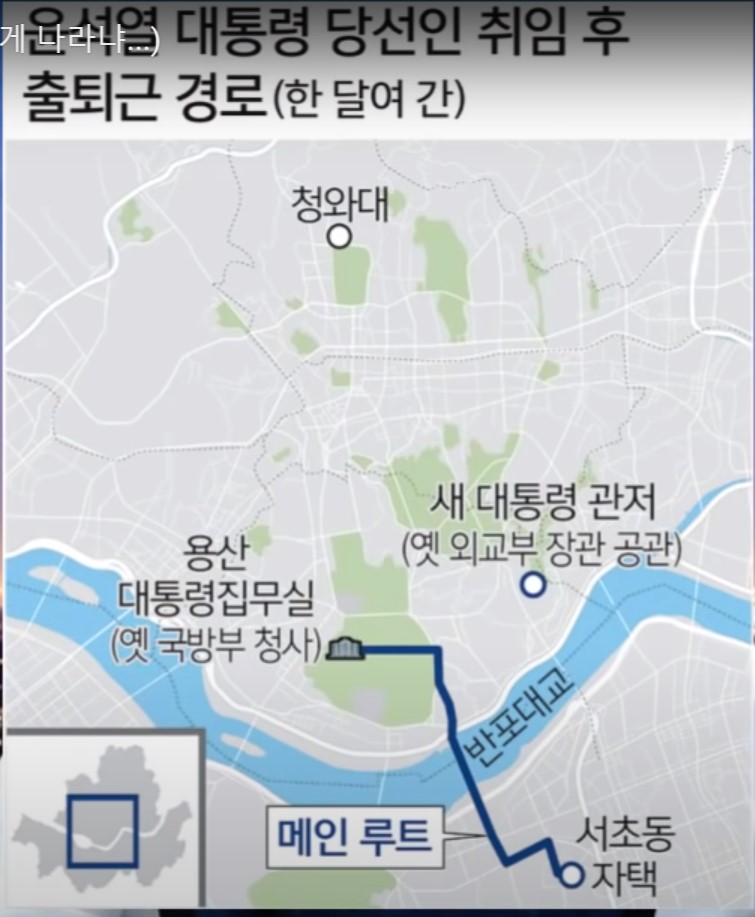
(Source- 언론 알아야 바꾼다 youtube 5.12 윤석열 안보 패싱! NSC도 폐지? ) Graphic shows the route to and from the former Ministry of National Defense Building on Yongsan base (north of the Banpo bridge across the Han River) to President Yoon's private residence in Seocho on the south side of the Han River. It also shows the location of the former Foreign Minister's official residence in Hannamdong, (right, north of the Han River) which Yoon and wife intend to use after it is renovated (in one month?). The Blue House (top center) former site of the president's office and also the location where the president's official residence has traditionally been located is shown north of the Yongsan base.

A critic joked, the president probably left the office to do some drinking. He likes to drink somek ( 소맥 ), a boilermaker made with soju and beer. President Yoon isn't even in office three days and the security gap created by his refusal to move into the Blue House where the South Korean presidents traditionally lived and directed NSC meetings from the national command center underground is already on display. Why? Because some wizard guru, Gosa Jeon Gong, a youtube figure, apparently informed him and his wife, that the Blue House had bad feng shui ( 풍수 ) and that Yongsan military base where the former MND building is located had better geomancy. No joke. No comment from the conservative South Korean media. The new president is a Milton Friedman privatizer and anti-labor, that's all that matters to them. Yoon said during the campaign it was okay for employees to work 120 hours a week, but it seems he treats the Presidential office as a nine to five job and isn't available in a threat situation. The president's constitutional authority and responsibility for national security was apparently delegated to subordinates. So much for the notion promoted during the campaign that the conservative candidate with no foreign policy or national security experience whatsoever would be better for national security.


Note: 5.19 박정호의 핫스팟] 김병주 "NSC 열지 않은 윤석열 정부, 그게 바로 안보 공백" 쓴소리 Democratic National Assembly member Park Byung-chu (former four star general) elaborated in this OhMyNews TV youtube, additional details on the implications of Yoon's Security Office's failure to arrange for the meeting of the NSC on 5.12 in response to the triple ballistic missile launch by North Korea. https://www.youtube.com/watch?v=Pgec3BIl-Rg

Wednesday, May 11, 2022

On ROK cooperation with NATO cyber defense center


Only 5 states in Asia support sanctions against Russia, those are Japan, South Korea, Taiwan, Australia, and New Zealand. ASEAN is opposed. India is opposed, among others. With Indian opposition, the poor efficacy of the Quad as a new cold war mechanism against China and Russia is highlighted. This is why the AUKUS arrangement was developed. Japan, is not really committed to oil and gas sanctions on Russia, not wishing to lose its position in the international consortium with Russia in the Sakhalin gas project. Chevron and Exxon pulled out, Japan didn’t.

South Korea tends to view intelligence cooperation agreements, such as that with the US and Japan, as necessary to its security needs particularly against North Korea, but not as provocative to China as commitments as “boots on the ground” or other hard military asset commitments.

It is true that with the election of Yoon Suk-yeol who represents the legacy Japanese collaborator and military dictatorship elites in the conservative party, South Korea will become more compliant with Japanese and US anti-China initiatives. The fact is that this will hurt South Korean national interests which are similar to those of ASEAN countries who need to maintain a more ambivalent posture toward the new cold war in order not to damage their trade relations and security interests vis a vis their largest trading partner China.

With the election of Yoon Suk-yeol as president of South Korea, it is more likely to take unwise positions damaging its relationship with China. These would include abandoning the “three noes policy” adopted by the Moon Jae-in administration. No further disposition of any ABM system designed to be used against China, no participation in an anti-China alliance anti ballistic system, and no participation in a military alliance directed against China. The other trip wire for South Korea-China relations would be for it to make some statement of commitment to the security or independence of Taiwan that goes beyond its recent boilerplate and vague commitment to security in the Taiwan Strait which can be taken as merely a statement of support for freedom of navigation in the East China Sea region.


The publicized announcement of a NATO military commitment against China is a substitute for a failed effort by the US to raise an actual regional block against China that goes further than Japan, Australia, and New Zealand, the so called “white countries.”

North Korea didn't need the Ukraine war to remind them of anything


The US unilaterally abandoned the nuclear negotiations with North Korea at the Hanoi summit. To placate neocons and US national security opposition to negotiations with North Korea, then President Trump said, "Sometimes you have to walk."

At the Hanoi summit, the US negotiating team, led by John Bolton, officially adopted the "one bundle" approach to denuclearization in North Korea. This is also known as the all or nothing approach, and the "Libyan approach." North Korea didn't need any more examples of US unwillingness to negotiate. The national security sector of the US economy, and the associated think tanks, academic endowments, and their spokesmen in the media, know that any success or rapprochement with North Korea jeopardizes the US alliance with Japan, which contrary to their public statements is adamantly opposed to negotiations with North Korea that are anything short of a total surrender. Therefore, no intermediate "step by step" process that relies on reciprocity and trust building among the parties can be allowed. Russia, China, South Korea, and North Korea, all favored the step by step approach.

The US military complex in northeast Asia has no raison d'etre without the ongoing 70 year conflict with North Korea. Proposals for negotiations with North Korea are just not taken seriously in the US. Claims that the US is open to negotiations with no conditions are just posturing for public relations purposes. Efforts by South Korea's Unification Ministry were vilified in US media during the entire Moon Jae-in administration while they were threatened with sanctions and told to get in "lock step" with the US and Japan which have zero consideration for Korean national aspirations. Regardless of the improvidence of the recent North Korea ICBM launch, the recent US-Japanese carrier strike force operating in the East Sea/ Sea of Japan merely cements North Korean perception of the hostile intent of both nations toward them. It's the same old gunboat diplomacy from both countries during the imperialist era of the 19th Century that they know so well after it culminated in two million or more deaths in Korea during the Korean conflict, and a brutal and oppressive Japanese occupation long before that.

Koreans didn't need Ukraine to remind them of anything. Japan wants to whitewash its past. The US ignores any Korean history before June 20 1950 and its saturation bombing campaigns thereafter that destroyed virtually everything in North Korea. US diplomats ask stupidly "why can't they get over it?" Koreans will never forget.


Thursday, May 5, 2022

Ukraine war is a heaven sent opportunity for Japan’s right


(Source 호사카유지TV/ OhMyNewsTV May 2) “우크라 전쟁은 하늘이 준 기회”... 아베가 다시 움직인다
Professor Hosaka Yuji, "Ukraine war is a heaven sent opportunity"...Abe is on the move again. Picture shows Abe giving a speech on constitutional revision at a venue in his Yamaguchi Prefecture district, April 3. Abe has been stumping for the Constitution revision to remove Art 9 restrictions on Japanese self defense forces to permit offensive warfare capabilities, like a "normal country."

The professor who is an analyst of Korean-Japanese relations and Japanese politics goes on to describe how the far right elements of the LDP (whose views are typically carefully screened from western view by compliant English language media) see the future conflicts with Russia and China requiring a solid military alliance with the US with greater Japanese military contribution and the encouragement of greater international support in Asia against Russia and China. This Japanese view anticipates an outcome from the ongoing conflict and perhaps additional future wars, providing the groundwork for a new international system, either in the UN or similar international institution arising in the aftermath of conflict, in which Japan is elevated to Security Council status among the victorious states, while great powers like Russia and China are replaced or excluded. The process requires Japan to abandon its three non-nuclear principles along with the current Constitution’s rejection of the use of war to resolve international disputes. An interim objective would be to have Japan join the AUKUS nuclear oriented military alliance in lieu of the Quad which appears to be faltering as a basis of an anti-Russian or anti-China military alliance due to India’s equivocation demonstrated clearly in the context of the Ukrainian war. The Japanese right sees Japan as leaving behind for all time, its history as a “war criminal nation,” (which it denies in its revisionist view of history as an unfair stigma undermining Japanese pride as a people). So in the LDP’s right wing ideological vision it’s time to abandon the San Francisco Treaty system to join the ranks of the future victors in a new world order in the war against China and Russia.