There is an apologia for the cult up over at the NY Times:
Being Called a Cult Is One Thing, Being Blamed for an Epidemic Is Quite Another
How one mysterious church became a lightning rod for South Koreans’ anger over the coronavirus outbreak.
By Raphael Rashid
https://www.nytimes.com/2020/03/09/opinion/coronavirus-south-korea-church.html
The misleading opinion creates the straw man that the democratic administration of Moon Jae-in "stumbled" in handling the corona outbreak at first, and attacked the cult in defense of domestic political criticism. That is, Moon Jae In's government uses the Shincheonji cult as a scapegoat and blames it for "starting" the epidemic in South Korea. This is consistent with the NY Times preference in favor of far right politicians in South Korea who toady to US policy. The biased opinion represents little more than an attempt to influence the news cycle in South Korea as the general election looms, on April 15, 2020, rather than the Presidential election in 2022, on which the opinion erroneously focuses. In the election taking place in just weeks the prospects of the right wing opposition are uncertain in contrast to the image created by the Times' opinion.
The Times opinion article is a sham. It follows the lead of a similar New Yorker magazine article that likewise ignores the basic facts including the chronology of events surrounding the cult and the covid 19 epidemic in South Korea. That chronology is discussed in my post immediately below. In the Times opinion is no discussion of the church's connections to Wuhan, and specific acts, omissions, and misrepresentations, exacerbating the epidemic in South Korea.
https://civilizationdiscontents.blogspot.com/2020/03/shincheonji-is-responsible-for-covid-19.html
Lee Man-hee's press conference on March 2, was a carefully orchestrated show. He "apologized" and bowed to the people and government of South Korea twice, prominently displaying his Park Geun-hye, solid gold presidential watch, in an attempt to elicit more political support from the right. He affected either being hard of hearing, or incompetent, and had to use an assistant to answer questions incorrectly. It was a very cunning display in a futile attempt to elicit sympathy and support in a situation warranting neither. In the end, virtually no information was elicited, except that "case 31" is responsible for everything. In contrast to the image of senility, Lee and his staff are in complete control of church officials and members on a daily basis according to former members.
One former organization insider said on a YTN news interview today that had Lee Man-hee, who has the status of a god or a dictator wished, and given the word, every single one of his followers would have shown up for corona virus testing in South Korean jurisdictions affected within one day's time. The organization's lack of full cooperation and disclosure is intentional and the recent public statements, apologies and offers of money and cooperation are a pose to disguise their culpability for recklessly aggravating the outbreak beyond all reason.
It is reassuring to know, that a prominent expert on Korean affairs such as T.K. over at Ask a Korean.com has posted a twitter thread today panning the Times opinion for similar reasons. Many medical experts recognize that the South Korean response to the outbreak is the most advanced public health effort of any seen yet in response to this epidemic. Had it not been for the secretiveness, evasiveness, misrepresentations, and lack of cooperation from this delusional cult, the crisis in South Korea would be well in hand at this point.
https://twitter.com/AskAKorean/status/1237040584851939328
Showing posts with label Shincheonji. Show all posts
Showing posts with label Shincheonji. Show all posts
Monday, March 9, 2020

Friday, March 6, 2020
Shincheonji is responsible for Covid 19 getting out of control in South Korea
According to a recent news report, 53 percent of South Koreans approve of the Moon administration's handling of the novel corona virus outbreak in South Korea. There is a right wing interpretation of recent events in the New Yorker by Suki Kim that tries to blame President Moon Jae-in for the massive run up in covid-19 numbers.
On January 26th, three days after China’s lockdown on Wuhan, the Korean Medical Association, the country’s largest association of doctors, urged the government to temporarily bar entry to all travellers arriving from mainland China. Moon’s government did not heed that warning. Instead, it donated a million and a half face masks to China. Moon’s defenders point out that the World Health Organization does not recommend a travel ban for virus prevention...*
*How South Korea Lost Control of Its Coronavirus Outbreak
By Suki Kim, March 4, 2020.
https://www.newyorker.com/news/news-desk/how-south-korea-lost-control-of-its-coronavirus-outbreak
The New Yorker opinion piece omits certain critical facts that haven't received much press attention abroad because the organization responsible for the massive increase in cases, the Shincheonji cult, was and still is, withholding material information related to the spread of the disease. The epidemic in South Korea, could have been better contained but for the secretive, delusional and manipulative orientation of the cult.

The Shincheonji organization concealed it's activities in Wuhan, China. There is a video of Shincheonji spokesperson on March 2, 2020, making a misleading statement stating they had closed their church in Wuhan in 2018. The Chinese government closed the church, but the congregation's members continued to meet for church activities. In Wuhan, after the epidemic became public knowledge there, the Sincheonji reported they were meeting "online." Allegedly, up to some point in December, they had been meeting several times a week in private locations such as cafes, homes and apartments conducting church related functions in groups as large as 20 or more, in confined spaces. One of these locations was only five kilometers from the seafood marketplace in Wuhan suspected to be a nexus of early covid 19 transmission. Three other locations were not much further away inside Wuhan. The JTBC investigative report disclosed 356 Sincheonji Wuhan members into late 2019. Where are they now? This is under government investigation. The church claims it doesn't have the ability to track the whereabouts of its "210,000" members. A document obtained by the JTBC program showed the church maintained 160 evangelical locations (Gospel rooms) in Wuhan.
According to insiders familiar with the organization's practices, an influx of Shincheonji members into South Korea, from overseas, including Wuhan, probably occurred on or before January 12, 2020, when the annual general assembly of the church took place in Gwacheon, South Korea. At the January 12, general assembly of the church, the presence of members from the Chinese elements of the Seoul chapter of the church was acknowledged on a recorded video.
A former church member reported on Lee Kyu-yon's Spotlight investigative journalism program, (March 6, youtube) that a further influx could have taken place on or after January 19, 2020, in anticipation of the lunar new year's holiday. Both of these potential avenues of transmission took place before the Chinese quarantine on travel outside Wuhan on January 23 took effect. Two spotlight sources, respectively, stated that it would be natural to expect sect travelers from China in South Korea during these two periods in January. The key events took place before the dates cited as pertinent in the New Yorker opinion. According to a source, reported by the SCMP, the members had all left Wuhan for the lunar new year break. Current news broadcasts in South Korea indicate based upon public health tracking, that 63 percent of all covid 19 infections are known to be related, directly and indirectly, to the secretive cult. A look at the cluster distribution around Daegu, Gyeongbuk, and Cheongdo, suggests circumstantially, that the true number is closer to 90 percent. The Daegu cluster is directly related to the Sincheonji church in that city.
It is documented that church public relations directed followers when interviewed by public health investigators to lie about their contacts with known carriers of the corona virus from the church, and to deny attending church services. The investigation by government officials was characterized as "persecution" of the church. According to the church, this action was the responsibility of one misguided church official.
The leader of the cult, Lee Man-hui, at his press conference has attempted to hold one member,known as "case 31" personally responsible as a "super spreader" for the catastrophic outbreak in Daegu, Gyeongbuk, Cheongdo, and related commmunities. This obviates several dimensions of the problem. There remains the consistent effort by the cult to obscure the Wuhan connection from the government and public. Believers were told and this was recorded in one congregation in Pusan, that members from Wuhan were not infected, and that believers would not be affected by the virus. The behavior of case 31 is consistent with a delusion within the sect that sickness is the sign of the devil, and in this specific epidemic, the devil's blow against the organization. This explains why patient 31 refused the covid 19 test on two occasions while infected, and attended packed worship services while symptomatic. It also explains why members of the church told to self quarantine, continued to play active roles in the outside community, including 2 infected members who provided public health services and failed to reveal their Shincheonji affiliation until symptomatic with virus and proven to have covid 19.
Another interesting aspect of the New Yorker criticism citing later dates when the Moon administration placed restrictions on travelers from China, is the attempt to compare Moon's administration to Park Geun-hye's negligent handling of the Sewol ferry disaster. It hasn't gone unnoticed that Lee Man-hui wore his gold "presidential" watch, allegedly presented to him by the impeached and imprisoned President Park during his "apology" press conference which only lasted minutes. This is because his anti-science, delusional christian fundalmentalists were a key part of her base in the Saenuri Party. They are not the only religious fundamentalist supporters of Park that have defied public health efforts during the epidemic. Conservatives promoting blame of the Moon administration's public health efforts are merely covering for the far right base of religious fundamentalists.
A church spokesperson for the foreign chapters says no church members returned from Wuhan, China, from December thru January. This is an unsupported conclusory allegation inconsistent with the statement that the organization is incapable of knowing the whereabouts of its members. The government investigation of this aspect of the church's activities is ongoing. Given the circumstances, it is unlikely that this is true. In contrast to the New Yorker hit piece, the alternative explanation of the "failure" to contain the virus during the so called "golden period," was essentially the result of a pattern of acts, omissions, and misrepresentations by members and leaders of the Shincheonji cult which continues to conceal elements of their membership, their contacts among themselves, and their ties to the travelers from China who left before January 23 and arrived in South Korea before January 26.
Then there is this published in the Korea Times:
The Ministry of Justice said it checked the immigration records of around 245,000 Shincheonji followers at the request of the health authorities as the bulk of infections are linked to a branch church of the fringe sect in the southeastern city of Daegu.
Of the total Shincheonji followers, around 3,600 arrived here from China between July 1, 2019, and Feb. 27, 2020, the ministry said. Among them 42 traveled from the central Chinese city of Wuhan.
42 Shincheonji followers came to Korea from Wuhan over eight months
Korea Times updated : 2020-02-29 19:10
https://www.koreatimes.co.kr/www/nation/2020/03/119_285338.html
The figure of 42 persons from the Wuhan chapter of Shincheonji returning to South Korea seems disproportionately low. Where are the rest of the 356 members? Of the eleven chapters of Sincheonji in China, the number of 356 members taken from a church document seems correct. 356 / 3600 is about 10 percent. But only 42 returned to South Korea?

Here is another late report demonstrating evasion of public health measures by Sincheonji followers:
A cluster of 46 Shincheonji related covid 19 cases was discovered March 8, at the the Han Maeum Apartments in Daegu. Two thirds of cases are Sincheonji members. The members had been meeting in three separate places ten people at at a time, spreading the infection. Two of the Shincheonji persons were confirmed cases who violated health regulations by not following directions from health officials to quarantine themselves. 9 of the cluster cases had to be hospitalized. Others were moved to an intermediate care center for quarantine, observation and treatment. (Source is MBC News, 3/8/20) The Daegu authorities had given notice that any Sincheonji who do not turn themselves in for examination by tomorrow will be prosecuted.

Daegu public health officials announced that their investigation of Shincheonji members as potential carriers of the Covid 19 virus was "95 percent complete." For the time being the rate of increase in the number of Daegu area corona virus cases seems to be slowing as shown by the graphic above. But for the Sincheonji cluster at the Maeum Apartment complex, the increase in cases today would have been significantly lower.

So out of 7,134 cases at the start of the day 3.8, cases related to Shincheonji clusters in Daegu and Gyeongbukdo, are 5.381 and 1,081 respectively. This is 90 percent of all cases in South Korea. The cases officially determined to be connected to the cult, directly or indirectly at this point by public health authorities is said to be 63 percent.
Wednesday, February 26, 2020
Shincheonji cult and the explosion of covid 19 cases in South Korea
edited and revised 2.27
According to a BBC article:
"Shincheonji contributed significantly to the sharp rise in the number of patients in Korea," Won Suk-choi of the division of infectious diseases at the Korea University College of Medicine, told the BBC, but he also warns that "the situation Korea is currently experiencing can happen anywhere in the world".*
*Coronavirus: Why did infections shoot up in South Korea? Feb. 25, by Andreas Illmer, https://www.bbc.com/news/world-asia-51609840
There is an attempt by Sinchionji related sources to deny any responsibility for the rapid spread of the disease to Daegu and Cheongdo, South Korea. The contagious disease had already started spreading widely in China by the time the last of the church/cult members finally left Wuhan. By then the South Korean government was already well aware of the epidemic as evidenced by the advance warning to stay home rather than travel over the lunar holiday period starting January 25. It's fairly clear from the BBC article that a key event in Cheongdo, South Korea, occurred at the end of the January. Cheongdo was a nexus site for contagion in addition to the Sincheonji church in Daegu. While the source of the infection to the so called super spreader "case 31" from the Sincheonchi Church in Daegu, is unproven, it is likely that communication of the infection took place as a result of the church's evangelical activity in Wuhan, China. Case 31 denied going to the funeral event, but admitted going to a public sauna in Cheongdo.
A South China Morning Post article quotes a source that Sincheonji members in Wuhan had stopped attending worship services "by December." Some members may have stayed in Wuhan for weeks afterward, while the epidemic raged. According to the SCMP, "She said the group was continuing to share sermons and teachings online, but most members had returned home at the start of the Lunar New Year holiday in late January.*"
*Coronavirus: secretive South Korean church linked to outbreak held meetings in Wuhan until December.
Around 200 Shincheonji Church of Jesus members continued to meet in the Chinese city amid rumours of virus, but ‘no one took [claims] seriously’ at first. Around half the Covid-19 cases in South Korea have been linked to members of the religious group
Mimi Lau, Published: 10:24pm, 25 Feb, 2020
https://www.scmp.com/news/china/politics/article/3052322/coronavirus-secretive-south-korean-church-linked-outbreak-held
At first, the Sincheonji cult erased web evidence they had a congregation in Wuhan; told their members that in spite of having members in Wuhan that may have returned to South Korea, that no one was infected and that they were protected by god; that righteous believers did not need to wear masks, etc. A possible scenario emerges where persons connected to the Wuhan church group returned to South Korea and spread the virus before the South Korean quarantine measures were put in effect for Korean travelers returning from China.
It is likely that members involved in Sincheonchi in Daegu interacted with the Wuhan Sincheonji travelers and when they experienced cold like or flu like symptoms simply were in denial and kept going about their business: going to Sunday services; meeting prospects from the language school across the street from the church for Chinese ethnic Koreans (so they can read and understand Bible passages); and doing "voluntary work" at the local hospital, etc. The known Sincheonji spreader, Case 31, went to the Daegu church four times, two times asymptomatic, two times symptomatic. She probably wasn't the only one. The funeral at the Cheongdo hospital funeral service facility for the sect founder's brother was believed to have drawn travelers from overseas perhaps including China. Another news report in South Korea said “case 31” refused covid 19 screening twice after being symptomatic. One news report alleged that the leader's brother died from “pneumonia." The entire psychiatric ward at the Cheongdo hospital is now reported to have been infected with the virus. Four patients from the Cheongdo hospital have now died from the virus. The government's investigation of the funeral service attendees still is ongoing.
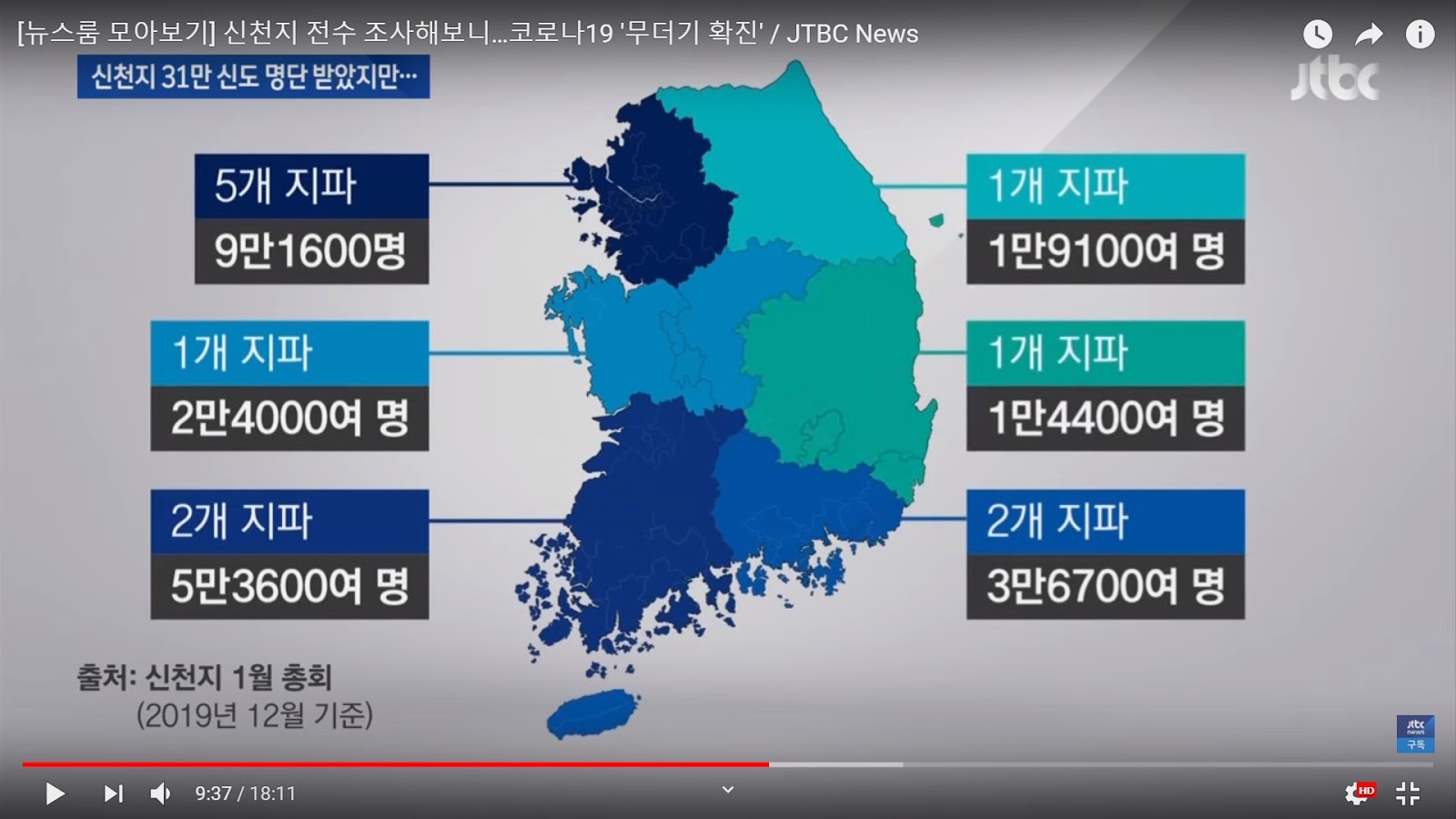
According to earlier South Korean reports, church membership lists provided by or taken by legal government process from Sincheonji congregations in South Korea for epidemiological screening and tracking didn’t include the lists of young people in the teens and twenties being recruited by the organization through their bible study program. Apparently this is now remedied, but approximately half of the additional 70,000 persons, have not yet been tracked down by local health authorities to determine their status. The estimated total number of people then related to the Sincheonji church is not 240,000 but closer to 310,000 persons. In other words, people waiting to become members are not members yet.
If one is familiar with the modus operandi and psychology of Korean congregations like this, they can be secretive, and jealous of their “human resources,” which are often taken from rival church congregations. Their "evangelism" takes on a predatory characteristic in the view of rival congregations sometimes infiltrated for recruitment purposes. People and practices are treated as proprietary interests and jealously guarded. On the other hand, members uncooperative disposition to provide information is often attributed to the group's "unpopularity," with the outside world. This appears to present a major difficulty in controlling the epidemic. The group's practices including close physical contact in crowded venues, instructions that preventative masks are a sacrilege, that members are protected by their faith from the virus, contributed to rapid contagion. There have been reports that when the church's facilities were closed, members continued to meet privately. Government warnings to church members to exercise self restraint and not go outside to public places have been ignored in documented cases where members continued to expose others and were later determined to have the virus.
Here is another instance involving a public health worker:
South Koreans vented anger after an official at a Daegu public health center that carries out virus tests continued to work even after he was told to get tested. He revealed he was a member of the Daegu Shincheonji church only after the test showed he was infected, Daegu officials said.*
* https://www.reuters.com/article/us-china-health-southkorea-church/secretive-church-at-center-of-south-koreas-explosive-coronavirus-outbreak-idUSKCN20L0Q8
Subscribe to:
Posts (Atom)